AI Act: Νέες απαγορεύσεις από 2 Δεκεμβρίου 2026 – Τι αλλάζει για επιχειρήσεις και χρήστες AI
Ο ευρωπαϊκός Κανονισμός για την Τεχνητή Νοημοσύνη ενισχύει την προστασία από τα μη συναινετικά σεξουαλικά deepfakes και το υλικό σεξουαλικής κακοποίησης ανηλίκων.
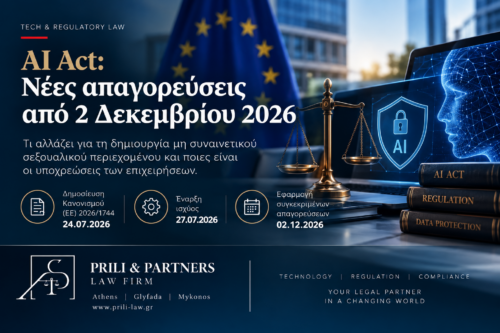
Από τις 2 Δεκεμβρίου 2026 τίθενται σε εφαρμογή δύο νέες απαγορεύσεις του ευρωπαϊκού AI Act, όπως τροποποιήθηκε με τον Κανονισμό (ΕΕ) 2026/1744.
Οι νέες διατάξεις στοχεύουν στην αντιμετώπιση σοβαρών κινδύνων για την ιδιωτικότητα, την ανθρώπινη αξιοπρέπεια και την προστασία των ανηλίκων.
Τι απαγορεύει ο AI Act;
Οι νέες διατάξεις του άρθρου 5 του Κανονισμού (ΕΕ) 2024/1689 αφορούν:
1. Μη συναινετικό προσωπικό υλικό σεξουαλικού χαρακτήρα
Απαγορεύεται, υπό τις ειδικότερες νόμιμες προϋποθέσεις, η διάθεση στην αγορά, η θέση σε λειτουργία ή η χρήση συστημάτων AI που δημιουργούν ή τροποποιούν ρεαλιστικές εικόνες, βίντεο, ήχο ή παρόμοιο υλικό, απεικονίζοντας αναγνωρίσιμα πρόσωπα σε σεξουαλικά ρητές δραστηριότητες ή εκθέτοντας απόκρυφα μέρη του σώματός τους, χωρίς την απαιτούμενη συναίνεση.
2. Υλικό σεξουαλικής κακοποίησης ανηλίκων
Απαγορεύονται, με τις προβλεπόμενες νομικές προϋποθέσεις, συστήματα AI που δημιουργούν ή τροποποιούν υλικό σεξουαλικής κακοποίησης ανηλίκων, συμπεριλαμβανομένου συνθετικού περιεχομένου.
Ποιες επιχειρήσεις επηρεάζονται;
Οι απαγορεύσεις αφορούν ιδίως επιχειρήσεις που αναπτύσσουν, διαθέτουν ή χρησιμοποιούν συστήματα παραγωγικής τεχνητής νοημοσύνης.
Για τους παρόχους, κρίσιμο είναι αν η δημιουργία απαγορευμένου περιεχομένου αποτελεί τον επιδιωκόμενο σκοπό του συστήματος ή ένα ευλόγως προβλέψιμο και αναπαραγώγιμο αποτέλεσμα χωρίς επαρκείς δικλίδες προστασίας.
Για τους φορείς χρήσης, η απαγόρευση συνδέεται με τη σκόπιμη χρήση συστήματος AI για τη δημιουργία ή τροποποίηση του συγκεκριμένου υλικού.
Συνεπώς, δεν απαγορεύεται γενικά η παραγωγική τεχνητή νοημοσύνη, αλλά συγκεκριμένες πρακτικές που πληρούν τις προϋποθέσεις του Κανονισμού.
Τι πρέπει να προσέξουν οι επιχειρήσεις;
Οι επιχειρήσεις οφείλουν να αξιολογήσουν τα συστήματα AI που χρησιμοποιούν, να εξετάσουν την επάρκεια των τεχνικών μέτρων ασφαλείας και να θεσπίσουν διαδικασίες αντιμετώπισης καταχρηστικής χρήσης.
Παράλληλα, η δημιουργία μη συναινετικού προσωπικού υλικού μπορεί να εγείρει αυτοτελή ζητήματα προστασίας προσωπικών δεδομένων, προσβολής προσωπικότητας και ποινικής ευθύνης, ανάλογα με τα πραγματικά περιστατικά.
Συμπέρασμα
Η 2α Δεκεμβρίου 2026 αποτελεί σημαντική ημερομηνία για την εφαρμογή του AI Act.
Οι νέες απαγορεύσεις ενισχύουν την προστασία των θεμελιωδών δικαιωμάτων, καθιστώντας αναγκαίο τον έγκαιρο νομικό και τεχνικό έλεγχο των συστημάτων τεχνητής νοημοσύνης.
PRILI & PARTNERS LAW FIRM
Athens | Glyfada | Mykonos
www.prili-law.gr
Το παρόν άρθρο έχει ενημερωτικό χαρακτήρα και δεν συνιστά εξατομικευμένη νομική συμβουλή. Για την προετοιμασία του χρησιμοποιήθηκαν εργαλεία τεχνητής νοημοσύνης. Το περιεχόμενο έχει υποβληθεί σε ανθρώπινο νομικό έλεγχο και συντακτική επιμέλεια πριν από τη δημοσίευσή του.
Νομικές πηγές:
- Κανονισμός (ΕΕ) 2026/1744, Επίσημη Εφημερίδα της Ευρωπαϊκής Ένωσης, 24.07.2026.
- Κανονισμός (ΕΕ) 2024/1689 (AI Act), άρθρο 5, όπως τροποποιήθηκε.
Ευρωπαϊκή Επιτροπή, AI Act Implementation Timeline.
EU AI Act: New Prohibitions from 2 December 2026 – What Businesses Need to Know
New EU rules address non-consensual sexual deepfakes and AI-generated child sexual abuse material, introducing additional compliance requirements for AI providers and users.
From 2 December 2026, two additional prohibitions under the European Union’s Artificial Intelligence Act (AI Act) are scheduled to apply, following amendments introduced by Regulation (EU) 2026/1744.
These provisions aim to strengthen the protection of privacy, human dignity, fundamental rights and children against serious risks associated with generative artificial intelligence.
What Does the EU AI Act Prohibit?
The amendments to Article 5 of Regulation (EU) 2024/1689 address two particularly harmful applications of artificial intelligence.
1. Non-consensual sexually explicit deepfakes
Subject to the specific legal conditions established by the Regulation, the new prohibition concerns AI systems that generate or manipulate realistic images, videos, audio or similar content depicting identifiable individuals in sexually explicit situations or exposing intimate parts of their bodies without the required consent.
2. AI-generated child sexual abuse material
The second prohibition addresses AI systems used to generate or manipulate child sexual abuse material, including synthetic content, under the conditions specified in the Regulation.
Importantly, these provisions do not impose a blanket prohibition on generative AI. Their application depends on the characteristics, intended purpose, safeguards and actual use of the relevant system.
Which Businesses Are Affected?
The new rules are particularly relevant to businesses that develop, provide, deploy or integrate generative AI systems.
For AI providers, legal assessment may involve whether prohibited content generation is an intended purpose of the system or a reasonably foreseeable and reproducible outcome in the absence of adequate safeguards.
For deployers, the deliberate use of AI systems to create prohibited content may fall within the scope of the relevant restrictions.
Businesses should therefore assess their AI systems, implement appropriate technical and organisational safeguards, and establish procedures to prevent and address misuse.
AI Act, GDPR and Criminal Liability
The new prohibitions may also interact with existing legal frameworks.
Depending on the circumstances, the creation or dissemination of non-consensual intimate content may raise issues under the General Data Protection Regulation (GDPR), national criminal law, personality rights and civil liability.
Compliance with the AI Act does not automatically establish compliance with these separate legal obligations.
Conclusion
2 December 2026 is an important compliance milestone under the EU AI Act.
Businesses developing or using generative artificial intelligence should review their systems and safeguards before the new prohibitions become applicable.
Early legal and technical assessment can help reduce regulatory exposure while protecting individuals’ fundamental rights.
⸻
PRILI & PARTNERS LAW FIRM
Athens | Glyfada | Mykonos
www.prili-law.gr
Official Legal Sources
- Regulation (EU) 2026/1744, Official Journal of the European Union.
- Regulation (EU) 2024/1689 (Artificial Intelligence Act), Article 5, as amended.
- European Commission, EU AI Act Implementation Timeline.
This article is provided for general informational purposes only and does not constitute personalised legal advice. Artificial intelligence tools were used in its preparation. The content underwent human legal review and editorial oversight prior to publication.